

Last year, after some prompting from vintage-riding friends, I decided I needed a vintage cafe racer. As you may know, cafe racers are the “next big thing” in custom bikes (as determined by the Next Big Thing Committee), replacing the showy, expensive, non-functional choppers of the early Oughts. A cafe racer is a vintage motorcycle—a model produced before 1980 seems to be the cut-off point—that has been stripped to its bare essentials, then modified to go faster, stop harder and handle better than it did when it rolled off the showroom floor so many years ago. The problem is, there are hundreds—maybe thousands—of eligible models to chop and form into cafe-racer luncheon meat. What to choose?
If all I cared about was authenticity, it would have to be something properly British. Maybe a Dresda-framed Norton (A Drixton)? A Norton-Framed Triumph (Triton)? Or a Sportster in a Norton Featherbed chassis (Narley)? Maybe a Vincent mill in a Norton roller (Norvin)? That’s fine for those of you with the time, expertise and buckets of cash necessary to properly get something like that running. And even running, what do you get? 450 pounds of vibrating, oil-leaking, unreliability that might make it 300 miles in a day or maybe not. Life’s too short.
I wanted reliability, light weight and good handling. Power? Torque? Cred with the wallet-chain-sporting Rockers down at the hepcat bar? Not a priority. Cool contraction name? I can make up my own. I knew I wanted a late-’60s bike (real Vintage guys laugh at ’70s bike owners), and I wanted a four-stroke (yes, I know you get all weepy at the smell of bean oil, but that’s because it’s actually just irritating your eyes). That probably meant a Honda, and I didn’t want a CB750—too big, too heavy, and I hate the rattle of the camchains on those things. It sounds like mechanical gargling.
That narrowed it down to a smaller Twin. The 450, I read and heard from others, just didn’t have the bombproof reliability of the 350 and 360. And the 160, though fun, just wouldn’t have the pep required for modern high-speed traffic conditions. Another plus of the 350 was the massive availability of parts. Honda sold hundreds of thousands of the CB, CL and SL 350 between 1968 and 1973. And from what I’ve seen, the average one got ridden for about a year and a half before it was parked between the lawn mower, snow blower and giant parakeet cage in the back of the garage.
But it wasn’t just a frizzy little chick bike designed to get new riders into Honda showrooms. It was actually a pretty sophisticated design, with an overhead cam, five-speed gearbox, dual carbs and oversquare engine dimensions (it displaced 325cc, not 350) that let it rev out to 10,000 rpm. That meant a claimed 36 hp at the crank (not much less than a Triumph of the same era) pulling around just 346 pounds of claimed dry weight. That’s better than Kawasaki’s Ninja 250R. So much for 40 years of progress. So what if I could lop off 50 or 80 pounds of pot-metal flab, pump up the motor 10 percent and get the handling to at least the level of a vintage roadracer? Sounds like fun, right?
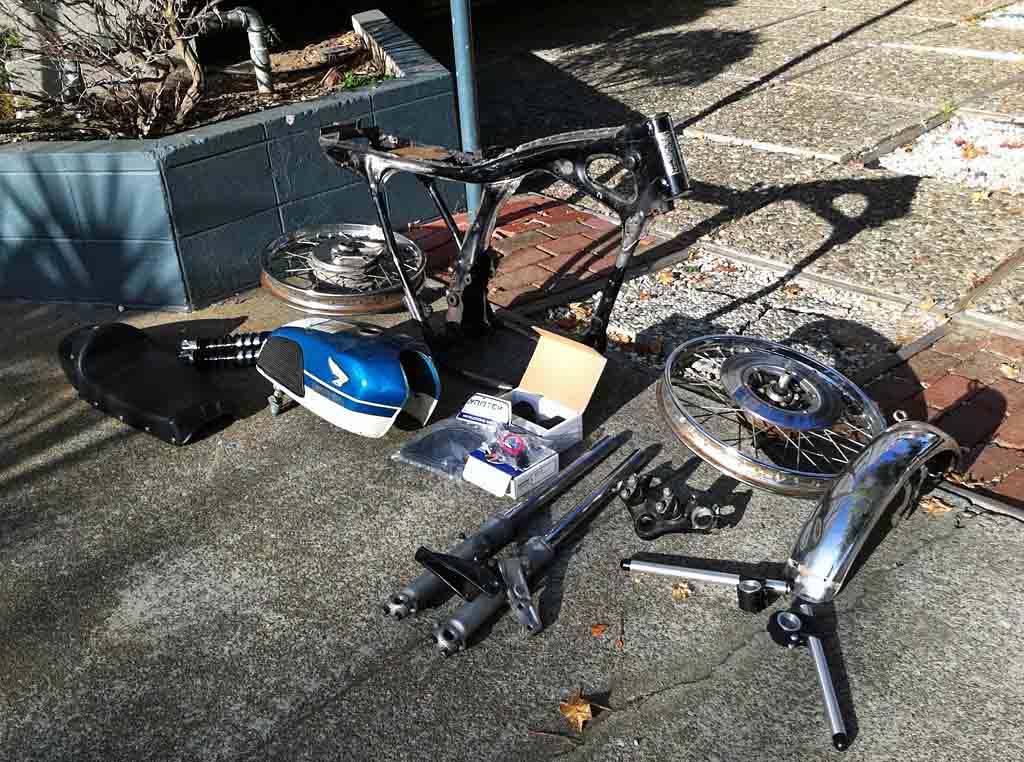
So who would build the bike? Not me, God knows: I can change oil or swap out parts, but I don’t have the patience, attention-to-detail, tools, garage space or other resources to properly do this. Really. So I emailed Charlie O’Hanlon. Charlie’s Place is the Bay Area’s leader in Vintage Honda restoration and repair, and you would be hard-pressed to find a more enthusiastic partner for this project. Charlie instantly got what I wanted: a stripped-down, bare-bones street-friendly AHRMA racer. Now I wouldn’t need a complete bike: he had everything I needed in his copious supply of ’60s and ’70s Honda bits. the rest I could leverage out of the network of suppliers for the vintage scene.

The plan: brace the frame and trim it down to save weight, bolt up a CB400F front end (to get a better fork and a disc brake), rebuild the motor with performance carbs, modern electrics and full racing exhaust, lace up new, lighter wheels with modern rubber, bolt up clip-ons, rearsets and modern shocks and replace the seat with a lightweight fiberglass tail. I once had a Honda FT500 Ascot pressed into service as a vintage roadracer, and it was one of the most fun bikes I ever rode on a racetrack—with 295 pounds gassed up and 54 hp, how could it not be? My little Honda would be in that vein, except I wouldn’t have to spend two hours heli-coiling camcover bolts for every three hours of riding.
The best part was I could skip that part of the bike-building TV show where we roll a rusty old hulk into my garage and start stripping, hacking and saw-zalling it to tiny pieces. Charlie has tons of used and NOS stuff in his attic (call him at (415) 255-0316 to see if he has that hard-to-find doodad you need), and Honda still offers much of the consumable items. It was time to start sending some emails and getting on the phone. I only had 30 or so years of riding time left…
Source : http://www.motorcycledaily.com/2011/03/md-project-honda-cb350-cafe-racer-part-i/


0 commentaires:
Enregistrer un commentaire