L'Administration

Bienvenue sur Tech Tent ® : Des nouveautés pour tous les fans du Site : Car Tech | Games Tech | Internet Tech | Mobile Tech | News Tech... Merci de votre attention !
Affichage des articles dont le libellé est Moto Tech. Afficher tous les articles

jeudi 28 avril 2011

Suzuki propose un Burgman 125 ''cadre dynamique''

Non, Suzuki n'a pas prévu de lancer sur le marché un nouveau scooter au châssis révolutionnaire ou autres suspensions électroniques, mais une édition spéciale "Executive" noir mat et fignolée de son Burgman 125.

Entrant "bonne roue, bon phare" dans sa cinquième année de commercialisation, le Suzuki Burgman 125 demeure une valeur sûre du segment - roi en France - des scooters 125 GT ! Si ses scores sont bien inférieurs à ceux du Yamaha Xmax, le scooter d'Hamamatsu domine en ce début d'année d'une courte tête les XEvo de Piaggio, Satelis de Peugeot et S-Wing de Honda (lire MNC du 12 avril 2011 : Premier trimestre 2011 inégal pour le marché du motocycle).

Afin de profiter pleinement du retour des beaux jours et de rester ainsi dans la course, Suzuki France a demandé à l'Espagne - aux usines de la marque qui s'y trouvent, pas à Zapatero... - de produire une version premium de ce scooter.

Baptisé "Burgman 125 Executive", cette édition limitée - à 400 exemplaires - se destine donc aux cadres dynamiques et autres hommes pressés des grandes villes françaises ("Executives" en anglais). Car pour rappel, Suz' conseille aux "Françaises pressées" l'achat du Sixteen, plus commode pour elles.

Au programme de cet Executive tout d'abord, se trouvent l'inévitable coloris exclusif noir mat accompagné d'une selle surpiquée de rouge. Des modifications qui à elles seules offrent au débonnaire Burgman - avouons que ce n'est pas le scooter le plus racé ou sexy du marché - un nouveau "look ravageur".

Or les Jaunes ne se sont pas arrêtés là, puisque sur cette version seulement, les compteurs sont à fond blanc, le feu arrière complètement rouge - et pas à moitié comme sur la version standard -, l'optique avant bleuté, la bulle fumée et son saute-vent réglable en hauteur, les fourreaux de fourche et les jantes peintes en noir...

Autant de petites touches qui apportent au Burgman 125 une classe supérieure et devraient séduire nos concitoyens. Le coût global de l'opération est d'ailleurs modéré puisque le Burgman 125 Executive s'affiche actuellement dans toutes les bonnes concessions Suzuki au prix de 3399 €, soit 200 de plus que le modèle de base.


Source : http://www.moto-net.com/actualites-motos-B3751-Nouveaut%C3%A9s-2011-Suzuki-propose-un-Burgman-125-%27%27cadre-dynamique%27%27.html

Aprilia Tuono V4 R et APRC : disponibilité, tarifs et vidéo


Dévoilées lors du dernier salon de Milan, les toutes nouvelles Tuono V4 R et APRC d'Aprilia s'apprêtent à débarquer dans les concessions françaises... Date de disponibilité, prix des deux versions et vidéo officielle : tout est en ligne sur Moto-Net.Com !

Disponibilité, tarifs et vidéo des Tuono
C'est en automne dernier à l'EICMA que Moto-Net.Com avait fait connaissance avec la Tuono V4 R. Bon nombre d'infos - dont deux erronées, ah ces gars de la communication !... - avaient été diffusées pour l'occasion, mais il nous restait à découvrir deux informations capitales : la date de sortie et le prix.
Avant de vous les transmettre, Moto-Net.Com tient juste à revenir sur les deux données qui, depuis la grand messe de Milan fin octobre, ont été modifiées...


Tout d'abord, ce n'est pas une mais bien deux Tuono V4 qu'Aprilia s'apprête à lancer sur le marché : une première version de base mais baptisée "R" et une seconde affublée du suffixe et du pack "APRC" directement piqué à la RSV4 Factory APRC (également disponible sur la RSV4 R, lire MNC du 12 avril 2011 : L'Aprilia RSV4 R adopte l'APRC en 2011).
Ensuite, pour la clientèle de sportifs invétérés que cible ce nouveau monstre - et pas Monster hein ! -, la modification la plus marquante concerne sans conteste la puissance maximale. Après avoir annoncé "162 chevaux à 11000 tr/min", Aprilia a revu cette sacrosainte valeur à la hausse.

Considérant sans doute que 162 ch faisait "petit bras" sur ce type de roadster sportif, les ingénieurs de Noale ont finalement limité la puissance du V4 (de 180 chevaux sur la Superbike originelle) à 167 chevaux que le moulin va chercher 600 tours plus haut qu'initialement prévu.
Le couple maxi en revanche n'a pas été touche : il atteint bien 110 Nm à 9000 tr/min. D'ailleurs, le reste de la fiche technique est scrupuleusement confirmé. Si bien qu'il ne nous reste plus qu'à livrer les informations commerciales...
Les deux modèles, Tuono V4 R et Tuono V4 R APRC, seront disponibles à partir du mois de mai dans les concessions Aprilia.
Le tarif officiel de la Tuono V4 R est établi à 13 999 €, mais Aprilia France nous fait savoir qu'un "prix de lancement de 12 999 euros dans le réseau concessionnaire participant" sera appliqué "jusqu’au 30 juin 2011".
La Tuono V4 APRC quant à elle coutera 14 999 €, soit le prix de la sportive RSV4 R "de base", ou 291 € de moins que la grande rivale Ducati Streetfighter dans sa version, elle aussi, "de base" (la Streetfighter S est affichée à 18990 €).
Petit bonus : quelques semaines avant de lâcher sa belle et sa bête en concession, Aprilia propose sur sa chaine officielle YouTube un avant-goût de se qu'elles proposeront...


Non vraiment, si les Transalpins placent autant d'efforts et d'attention dans la commercialisation de leurs toutes nouvelles Tuono qu'ils en ont mis dans cette brillante vidéo de présentation, les roadsters Aprilia sont promis à un bel avenir... Affaire à suivre, restez connectés ! 

source : http://www.moto-net.com/actualites-motos-4245-Nouveaut%C3%A9s-2011-NOUVEAUT%C3%89-2011-Aprilia-Tuono-V4-R-et-APRC-:-disponibilite,-tarifs-et-video.html

L'Aprilia RSV4 R adopte l'APRC en 2011

L'électronique "MotoGPesque" dévoilée par Aprilia sur la RSV4 APRC SE (Aprilia Performance Ride Control Special Edition) vous tente, mais la banque refuse votre demande d'emprunt de 21 999 € ? A moins que la décoration "Réplica Max Biaggi" sur ses carénages ne file de l'urticaire au fidèle supporter de Valentino Rossi que vous êtes ?


Aprilia On Track 2011
Dans le cadre des Journées portes ouvertes des circuits 2011 de la Fédération française de motocyclisme (FFM), Aprilia offre à 100 heureux élus l'opportunité de rouler gratuitement sur le circuit de Magny-Cours (58) le 22 avril. Inscription Aprilia on Track 2011 par email
Eh bien tout n'est pas perdu, car Aprilia a décidé d'installer son ultrasophistiqué système d'aides au pilotage (contrôle de traction réglable en roulant sur 8 positions, anti-wheeling et assistance au départ réglables sur 3 positions, etc.) sur la RSV4 R, le modèle de "base" de l'Hypersport de Noale !
Le constructeur italien n'a pour l'instant communiqué ni le prix, ni la date de disponibilité en concessions de cette RSV4 R APRC, mais si son inflation tarifaire reste contenue par rapport à la "R" (14 999 euros), cette salivante nouveauté 2011 pourrait donner bien du fil à retordre à la concurrence, à commencer par la surpuissante BMW S1000RR et autres Kawasaki ZX-10R 2011...

Source : http://www.moto-net.com/actualites-motos-B3724-Nouveaut%C3%A9s-2011-L%27Aprilia-RSV4-R-adopte-l%27APRC-en-2011.html

Triumph repositionne sa gamme et fait essayer ses motos

En présentant officiellement la Street Triple 2011 (lire MNC du 28 mars 2011 : la nouvelle Street Triple se dévoile et MNC du 23 mars 2011 : la Street Triple à l'aspi de la Speed ?), l'équipe dirigeante de Triumph France a également précisé le repositionnement de la gamme.
Toutes les Triumph à l'essai en avril !
Du 1er au 30 avril 2011, le réseau Triumph vous propose de venir essayer vous-même la Triumph de votre choix.
Vous pourrez profiter d'une offre de reprise personnalisée de votre ancienne moto ainsi que "d'offres exceptionnelles sur l'assurance Triumph (-15% sur votre prime annuelle et d'un taux de financement Triumph préférentiel)", explique le constructeur, qui organise également un tirage au sort pour "gagner un mois avec la Triumph de votre choix !"
Citant l'exemple d'une marque qu'il connaît très bien pour avoir été notamment directeur général de la filiale française, Jean-Luc Mars a notamment constaté que si les motards peuvent rentrer dans une concession Harley-Davidson en disant "je veux une Harley, peu importe le modèle", ceux qui rentrent dans une concession Triumph veulent d'abord "une Street" ou "une Dayto".
Aussi surprenant qu'il soit pour les vieux croûtons motards aguerris bercés au son des premières Bonneville, ce manque relatif d'image de marque a néanmoins conduit Triumph à un audit complet de sa gamme, afin de la rendre plus "lisible" par les blancs-becs motards d'aujourd'hui.
Custom, Fat Custom, Cruiser, Power Cruiser...
Ce repositionnement a ainsi conduit Triumph à réidentifier son nouveau Speedmaster (ci-dessous) en "cruiser d'entrée de gamme" avec ses références au style "Custom" : roue avant de 19 pouces, petit phare, garde-boue fin, finition noire de nombreux éléments, selle Gunfighter, etc.

Nouveau Triumph Speedmaster, cruiser d'entrée de gamme
De son côté, la New America destinée à "rassurer les nouveaux motards et enthousiasmer les pilotes les plus chevronnés" arbore les codes du "Fat Custom" : roue avant de 16 pouces, garde-boues larges, gros phare, finition chrome et peinture bitons avec liserés peints à la main.
Enfin la Thunderbird Storm, "cousine punk" de la Thunderbird, revendique plus clairement son statut de Power Cruiser avec sa finition noire, son guidon droit et son look radical.

Source :  http://www.moto-net.com/actualites-motos-B3678-Nouveaut%C3%A9s-2011-Triumph-repositionne-sa-gamme-et-fait-essayer-ses-motos.html

Nouvelles motos américaines : Motus MST et MST-R

Alors que la production de motos américaines de série s'articule généralement autour de généreux bicylindres chargés de propulser des customs plus ou moins clinquants, il faudra désormais compter sur Motus Motorcycles, un tout nouveau constructeur basé à Birmingham (Alabama-USA).
Car ce nouveau venu sur le marché du deux-roues sort très largement des sentiers battus avec son inattendue Sport-GT  dotée d'un 4-cylindres en V à 90° (la Motus MST) et sa déclinaison roadster, la Motus MST-R !
Élaborées dans le plus grand secret depuis 2009, ces américaines en sont aujourd'hui à un stade suffisamment avancé pour que les fondateurs de la marque (Lee Conn et Brian Case) lèvent le voile sur leurs aspects techniques...
Or, pour une marque née dans un pays où se traîner les pieds en avant "cruiser" est quasiment l'unique façon d'appréhender la moto, les choix technologiques laissent pantois : développé avec Katech Engines (un motoriste connu pour ses préparations sur les V8 de Corvette), le moteur est un inédit V4 de 161 ch installé transversalement dans un châssis treillis tubulaire !
Moteur KMV4 : 1645 cc, 161 ch et 165 Nm de couple !
Cubant 1645 cc, cette pièce d'orfèvrerie comprimée à 11,5:1 développerait quelques 165 Nm de couple. Elle embarque en outre une alimentation par injection directe qui permet une gestion plus fine du précieux mélange "air-essence".
Jouissant de "tonnes de couple sur une vaste plage de régimes" et d'une "fiabilité à toute épreuve" selon ses concepteurs, ce bloc baptisé "KMV4" refroidi par eau possède une sonorité grisante, proche de celle des V8 des Muscle-cars américaines (voir la vidéo de présentation des MST et MST-R ci-dessous).
Motus MST, l'anti VFR 1200 ?
Revendiquant le statut de Sport-GT, la Motus MST aborde un peu enveloppant demi-carénage en composite, des jantes en aluminium, un réservoir d'essence de 22,7 litres, une selle placée à 787 mm de haut... et une ligne générale qui ne brille pas vraiment par son originalité esthétique !


L'amateur de confort appréciera en revanche la présence de valises rigides et d'un pare-brise réglable, tandis que les plus sportifs noteront avec intérêt les mensurations contenues du bestiau : 1473 mm d'empattement, 26° d'angle de chasse et 227 kg à sec.
Clairement portée sur le sport-tourisme version "dynamique", la Motus MST exhibe une fourche inversée de 43 mm entièrement réglable, un mono-amortisseur ajustable en précontrainte et des disques à pétales de 320 mm pincés par des étriers monoblocs quatre-pistons à fixation radiale.
Les débuts de la production de cette Motus MST sont annoncés pour 2011 à un tarif non communiqué, pas plus que les caractéristiques techniques de la MST-R (la version roadster visible sur la vidéo ci-dessous).
Reste à espérer que cette intéressante initiative franchisse les frontières américaines afin que ces atypiques motos Motus puissent rallumer le flambeau de l'exotisme et du sport "Made in USA" : une flamme éteinte depuis la regrettable cessation d'activité de Buell en octobre 2009...

Source : http://www.moto-net.com/actualites-motos-B3690-Nouveaut%C3%A9s-2011-Nouvelles-motos-americaines-:-Motus-MST-et-MST-R.html

FZ8 R et SPR : le roadster Yamaha en version racing


A l'instar de Kawasaki avec sa Z750R, Yamaha fait également chanter l'R à la mode à sa FZ8 : décliné en versions R et SPR, le roadster Yamaha veut gagner en sportivité et en attractivité grâce à des pièces racing. Présentation.


Plébiscitée par les constructeurs européens (Aprilia, Ducati, KTM et Triumph en tête), la pratique consistant à proposer des variantes plus musclées - et plus chères - à partir de la même moto semble fait des émules auprès de la concurrence japonaise.

Dans l'R du temps
Déjà coutumier du fait sur son Hypersport YZF-R1, Yamaha a ainsi décidé d'upgrader son roadster de moyenne cylindrée en proposant deux "nouvelles" versions de la FZ8 : la FZ8 R et la FZ8 SPR.
Clairement inspirée par la démarche de Kawasaki et de sa Z750R (lire notre Essai de la Kawasaki Z750R), l'initiative des concessionnaires Yamaha vise à compenser le principal reproche fait à la FZ8 : son manque de rigueur en mode sport.
Doté d'un excellent châssis et d'un moteur à l'avenant, le roadster aux trois diapasons se montre en effet étonnement emprunté lorsque sonne l'heure de l'arsouille : la faute à une garde au sol faiblarde et surtout à des suspensions trop souples et à la cohésion perfectible.

Ces suspensions n'étant réglables qu'en précontrainte (et encore : seulement l'arrière !), les amateurs de bourres d'anthologie pouvaient rester sur leur faim...
Conscients que dans cette catégorie, nombreux sont les motards à rechercher des sensations fortes, les concessionnaires Yamaha ont donc voulu "renforcer le tempérament sportif de la FZ8 en privilégiant la performance, la précision et le look".
Yamaha FZ8 R
En réalité, la FZ8 R se contente d'adopter des éléments esthétiques (écopes latérales, sabot moteur, support de plaque, grille de radiateur, tampons de protection et stickers) et un silencieux Laser portant le logo "FZ8 R" !


Un peaufinage cosmétique qui ne demande pas les dons d'acuité cérébrale d'un mentaliste pour deviner que le comportement dynamique de la FZ8 R ne se trouvera pas transcendé par rapport à une FZ8 "standard" !


Estimé à 1391,38 euros par la filiale française, ce premier pack présente en revanche l'énorme avantage de n'être facturé que 390 € aux intéressés, puisque la FZ8 R s'affiche à 8389 € contre 7999 € pour la FZ8 standard : assurément une très bonne affaire !

Yamaha FZ8 SPR
Deuxième pack proposé par Yamaha Motor France, la déclinaison FZ8 SPR présente elle aussi un excellent rapport qualité/prix : contre 8699 euros, la SPR est dotée de tous les accessoires présents sur la FZ8 R avec en outre un amortissement arrière Öhlins dont la valeur est estimée à 680 €.
Certes, Yamaha aurait pu aller jusqu'au bout de la démarche en troquant les étriers de freins et la fourche d'origine contre des éléments plus performants (à l'instar d'une Triumph Street Triple R facturée 8990 €), mais cette Yamaha FZ8 SPR n'en demeure pas moins alléchante et bien placée sur le plan tarifaire face à sa rivale désignée : la Kawasaki Z750R (8599 €).

Source : http://www.moto-net.com/actualites-motos-4212-Nouveaut%C3%A9s-2011-NOUVEAUT%C3%89S-2011-FZ8-R-et-SPR-:-le-roadster-Yamaha-en-version-racing.html

La nouvelle Triumph Street Triple 2011 se dévoile

C'est désormais officiel : comme nous le pressentions la semaine dernière (lire MNC du 23 mars 2011 : la Street Triple à l'aspi de la Speed ?), le restylage esthétique (exit les phares ronds !) découvert sur le dernier millésime de la Speed Triple, roadster emblématique de Triumph, sera bel et bien appliqué à sa turbulente frangine, la Street Triple 675, dès ce printemps 2011 !

C'est ce que nous ont confirmé les responsables de Triumph France lors d'une conférence de presse organisée dans la nouvelle concession Triumph d'Ary et Axel Vilaseca, Elysée Motor (40 avenue de la Grande Armée, à la place de l'ancienne concession Saab).

La nouvelle Triumph Street Triple 2011 se dévoile
"First of all", la nouvelle Street Triple (disponible dès cette semaine dans le réseau Triumph) abandonne à son tour le double optique rond si caractéristique des roadsters Triumph et aborde les deux éléments pentagonaux de la toute dernière Speed (lire notre Essai MNC du 15 novembre 2010 : Essai Triumph Speed Triple 2011, the King is back !)

Parallèlement, quelques changements esthétiques rehaussent le niveau de finition de la petite anglaise, véritable chouchou des motards français : certes, elle ne "score" pas autant que la Z750 au niveau des volumes de vente, mais côté coeur il faut admettre que la petite Triple est très bien placée...

La nouvelle Triumph Street Triple 2011 se dévoile
Le directeur général de Triumph France, Jean-Luc Mars himself, recense pour Moto-Net.Com les modifications effectuées sur cette seconde génération de Street Triple : carters moteur désormais siglés Triumph, platine de repose-pieds, finition alu brossé de la ligne d'échappement, nouveau guidon aluminium, logos réservoir piqués à la Daytona R, cache-radiateurs inspirés de ceux du Speed, petits caches dans le triangle du cadre avec une grille "racing", etc.


La partie cycle dérivée de la Daytona et l'excellent trois-cylindres de 675 cc ne connaissent en revanche aucune modification, ce qui permet à la firme d'Hinckley de maintenir le tarif actuellement en vigueur (7990 € en version standard et 8990 € en version R) et de rester sur ses objectifs de ventes : entre 2500 et 300 unités sur l'année.

Source : http://www.moto-net.com/actualites-motos-B3673-Nouveaut%C3%A9s-2011-La-nouvelle-Triumph-Street-Triple-2011-se-devoile.html

Les nouvelles Norton sont homologuées Euro 3

http://www.moto-net.com/images/2011/Business/norton-homologue-euro3_s.jpgGrâce à l'homme d'affaires britannique Stuart Garner, Norton Motorcycles semble bien parti pour renaître des ses cendres. Le constructeur britannique vient de recevoir le sésame indispensable à la commercialisation de ses nouvelles motos : le certificat confirmant l'homologation et la conformité des splendides Commando 961 à la norme Euro 3 (lire notamment MNC du 22 décembre 2009 : Norton étoffe sa gamme).
Norton en Moto GP ?
L'installation des nouveaux locaux de Norton Motorcycles près de Donington Park (l'ancien circuit de Moto GP remplacé par Silverstone) ne doit rien au hasard : Stuart Garner n'a en effet jamais caché sa volonté de renouer avec le glorieux passé sportif de la marque (trois titres mondiaux en Grands Prix au début des années 50) en alignant une Norton en MotoGP dès la saison 2012 !
"Ils ont envoyé des lettres pour demander leur acceptation", confirme Carmelo Ezpeleta, le boss de Dorna (gérant des droits MotoGP) à MCN. "Mais nous leur avons dit que quand ils préciseraient avec quelle moto et quel moteur ils avaient l'intention de courir, alors seulement nous pourrons avancer".
Reste donc à concevoir un prototype MotoGP : des rumeurs font bien état d'une association avec Inmotec pour la réalisation d'un V4 de 1000 cc, mais le projet paraît terriblement ambitieux pour une "jeune" marque comme Norton. A suivre : restez connectés ! 
"C'est une étape importante qui vient d'être franchie par l'usine anglaise de Donington", se réjouit Norton Motorcycles en précisant que les premières Commando "destinées au marché français seront produites dans les prochaines semaines".
A court terme, Norton annonce une cadence de production "de quinze machines par semaine, les motos étant montées et assemblées à la main".
Ambitieux (lire encadré ci-contre), les responsables de Norton tablent sur une rapide augmentation du rythme de production "dans les mois à venir".
La gamme Norton "nouvelle génération" compte actuellement trois modèles : la 961 SE Commando, la 961 Commando Café Racer et la 961 Commando Sport.
En France, l'importation et la distribution de ces machines d'exception (près de 20 000 euros pour la Commando 961 SE !) sont assurées par le concessionnaire parisien Paradise Motorcycles.


Source : http://www.moto-net.com/actualites-motos-B3651-Nouveaut%C3%A9s-2011-Les-nouvelles-Norton-sont-homologuees-Euro-3.html

Ducati dévoile une décoration Valentino Rossi !

Les Rouges de Bologne n'ont pas perdu de temps : qu'importe que leur nouvelle étoile Valentino Rossi ne brille pas encore de mille feux en piste, son statut iconique suffit à concentrer l'attention sur Ducati, ce dont le constructeur italien profite en présentant la première décoration à la gloire du n°46 !


Monster Art : mode d'emploi
Dévoilé en 2009 (lire MNC du 10 juillet 2009), le projet Monster Art propose toute une série de décorations et de gamme de couleurs supplémentaires par rapport aux coloris d’usine, avec une collection appelée "Colour Therapy".
Une "customisation d'usine" en quelque sorte, puisqu'il est possible de décorer son Monster d'origine avec des coques de réservoir, un capot de selle, un saute-vent ou un garde-boue avant de son choix.
Les décorations et les coloris sont ainsi disponibles comme "accessoires" pour les Monster 696, 796, 1100 et 1100 S et le Monster 1100 Evo ou en couleurs originales sur les nouveaux Ducati Monster.
Quinze jours avant le lancement de la saison Moto GP au Qatar, le blason de Borgo Panigale a ainsi organisé, sur la Piazza Maggiore à Bologne (Italie), sa traditionnelle "Ducati MotoGP Night" où furent dévoilées les livrées "Rossi" et "Hayden", les nouveaux coloris proposés dans la palette du Monster Art (lire encadré ci-contre).
Le nouveau kit a été inspiré par les Ducati Desmosedici GP11 pilotées par le maestro italien et son coéquipier américain avec un design blanc sur un fond rouge et leurs logos respectifs.
"Ils sont ensuite personnalisés par la signature jaune "flash" de Rossi avec son fameux numéro 46 et le numéro favori de Hayden, le 69", précise Ducati.
Les deux champions du monde MotoGP (2002, 2003, 2004, 2005, 2008 et 2009 pour Rossi et 2006 pour Hayden) ont profité de l'événement pour saluer les quelque 38 000 fans présents sur place, après être arrivés aux commandes de leur prototype de Grands Prix (voir la vidéo ci-dessous).
Visiblement ravi de mesurer en "live" l'enthousiasme de ses supporters, Valentino Rossi a rappelé qu'il ferait tout "pour finir devant et faire du bon boulot".
Le Docteur italien et son "assistant" américain reprendront le guidon des Ducati lors du dernier test de pré saison Moto GP, prévu de nuit au Qatar les 13 et 14 mars.
Cette ultime séance d'essais sera particulièrement importance pour le team officiel, puisque la première course de la saison se tiendra sur le même tracé moins d'une semaine plus tard, le dimanche 20 mars...
"Définir une direction à suivre…"
Interrogé à ce sujet, Vittoriano Guareschi a déclaré savoir "exactement ce que nous voulons de la moto pour faire un bon début de saison". Le team manager des Rouges se veut publiquement confiant et prétend que ses pilotes commencent à maitriser la fougueuse GP11.
"La moto de Valentino est maintenant plus facile à piloter, lui et Jerry (Jeremy Burgess, le chef mécano de Rossi, NDLR) comprennent de mieux en mieux son caractère. Mais nous avons besoin de faire davantage de tests et de kilomètres".
"Nicky a commencé avec les anciens réglages et il a ensuite fait quelques changements en modifiant sa position, en relevant le guidon et en bougeant la selle. Après tout ce travail, les ingénieurs de Ducati ont tout ce qu'il faut pour continuer à avancer", conclut le team manager qui avoue cependant devoir travailler dur au Qatar afin "de définir une direction à suivre"... Restez connectés !

Source :  http://www.moto-net.com/actualites-motos-B3628-Nouveaut%C3%A9s-2011-Ducati-devoile-une-decoration-Valentino-Rossi-!.html

Zero Motorcycles lance sa 5ème moto électrique : Zero XU

Zero Motorcycles accroît son offre avec un roadster urbain baptisé Zero XU. Cette nouvelle moto "Zéro émission", cinquième de la gamme du constructeur californien de motos électriques, se distingue des deux précédents modèles routiers (Zero S et Zero DS) grâce à sa batterie amovible rechargeable plus rapidement.


Dérivée de la version tout-terrain Zero X, la nouvelle moto électrique Zero XU reprend la même motorisation développant 1,7 kwh et adopte surtout le même principe de batterie démontable : rechargeable en deux heures ou en moins d'une heure et demie avec l'option "charge rapide", elle peut être retirée du véhicule pour être branchée sur le secteur une fois arrivée à destination.


Cette caractéristique ouvre évidemment de nouvelles perspectives aux amateurs de motos "nucléaires", puisqu'il n'est désormais plus obligatoire de disposer d'un garage avec une prise secteur, à condition d'acheter le chargeur en option pour se raccorder à une prise 110 ou 220 V.
Evolutions sur la gamme Zero Motorcycles en 2011
Outre la nouvelle Zero XU, Zero Motorcycles fait évoluer ses quatre autres modèles en 2011. Les Zero S, Zero DS, Zero X, Zero MX peuvent désormais recevoir l'option "Charge rapide" qui réduit le temps de charge de presque 50%.
La motorisation Z-Force a aussi été renforcée, tandis que nombreuses pièces ont été changées (pneus, suspensions, freins, roues et indicateur de charge) au profit d'une meilleure efficacité.
Autre point marquant : les motos électriques tout-terrain (X et MX) sont dorénavant proposées en version homologuées route, tandis que l'ensemble de la gamme peut recevoir une transmission par courroie.
Enfin, la MX peut recevoir un moteur Agni annoncé comme "plus puissant" par Zero Motorcycles qui annonce avoir accru "les capacités des batteries de 12,5%" sur ces quatre modèles 2011.
"Le système de batterie amovible offre la possibilité d'un usage intensif, puisque la batterie peut être remplacée en quelques secondes sans outils : une solution parfaite pour les coursiers par exemple", ajoute Zero Motorcycles qui ambitionne "d'élargir sa cible de clientèle".
L'autonomie reste cependant contenue (entre 40 et 48 km) pour cette Zero XU sans embrayage et à transmission finale par chaîne, dont la vitesse de pointe dépasserait tout juste les 80 km/h (82 km/h selon le constructeur).
Enfin, outre les principaux changements esthétiques qui différencient la Zero X de la Zero XU (lignes plus effilées et guidon cintré sur la XU), ce nouveau modèle urbain se montrera plus accessible que la version tout-terrain avec une hauteur de selle qui passe de 84,5 à 80,6 cm.
La Zero XU est commercialisée au prix de 9995 € TTC (hors frais de mise en route et d'immatriculation) et les premières livraisons sont prévues courant (uhuhu !) avril 2011.

Source : http://www.moto-net.com/actualites-motos-B3618-Nouveaut%C3%A9s-2011-Zero-Motorcycles-lance-sa-5eme-moto-electrique-:-Zero-XU.html

Prix et disponibilité des BMW K1600GT et K1600GTL

https://blogger.googleusercontent.com/img/b/R29vZ2xl/AVvXsEisLFkvYkyx9ze2cU_nt-TMefNJRi2q3P01v6BxuJpxXnVcXG_FUj8aD47gAU3HZ1a_oXAV6MyRWDr9JxGb0E-WmZxWFw3Ji0l6peHt6gxA1hjwf0fm10CHqaPBVZtyrX3PCaXqGr6OjbYf/s1600/2012+BMW+K+1600+GTL.jpg

BMW Motorrad vient de dévoiler les prix et les disponibilités des K 1600 GT (20 400 €) et K 1600 GTL (22 350 €). Ces deux routières haut de gamme, motorisées par un six-cylindres de 1649 cc, seront disponibles à partir du 19 mars dans le réseau BMW et à l'essai sur Moto-Net.Com dès la semaine prochaine !
La BMW F 800 R à 7990 €
Jusqu'au 31 juillet 2011 chez les concessionnaires BMW Motorrad participant à l'opération, l'ABS est offert sur la BMW F 800 R, soit un avantage client de 825 €. Le troisième roadster de la marque allemande (avec les R 1200 R et K 1300 R) s'affiche ainsi à 7990 € avec le système d'assistance au freinage.
Prenant place dans la gamme "Tour" du manufacturier allemand, ces deux nouveautés 2011 très attendues seront équipées en série de feux arrière et clignotants à LED, de projecteurs au Xenon, de selles et de poignées chauffantes, d'un régulateur de vitesse, d'un tableau de bord de couleur, d'un ordinateur de bord avec commande au guidon "MultiControler", d'un ABS iIntégral, d'un pare-brise électrique, de trois modes de conduite et d'un embrayage anti-dribble.  
La K 1600 GTL, la déclinaison encore plus confortable et luxueuse, recevra en outre un système audio avec préparation GPS "Navigator" et un top-case. BMW Motorrad précise que ces prix comprennent les frais de transport entrepôt/concessionnaire, les frais de préparation à la route, deux ans de garantie et une assistance 24h/24 pendant trois ans à compter de la première mise en service, ainsi que la main d’oeuvre offerte pour la première inspection à 1000 km.
Rendez-vous dès la semaine prochaine sur Moto-Net.Com pour découvrir nos essais des BMW K1600GT et K1600GTL : restez connectés !

Source : http://www.moto-net.com/actualites-motos-B3595-Nouveaut%C3%A9s-2011-Prix-et-disponibilite-des-BMW-K1600GT-et-K1600GTL.html

Motana France distribue les cyclos Tomos


Surfant sur la vague Vintage qui fait la réussite des répliques de Dax en France, mais aussi celles des Van Van, Bonneville, V7 ou autres W650 (et 800 !), Motana France (Derbi) devient importateur exclusif des cyclomoteurs Tomos. Explications.


Créée en 1954 en Slovénie (ex-Yougoslavie), la marque Tomos a connu le succès dans les années 60 grâce notamment à ses "Colibri" : sur son marché national naturellement, mais également aux Etats-Unis (!), dans les pays nordiques et tout particulièrement aux Pays-Bas. 

C'est d'ailleurs en Hollande, dans la région de Gueldre à Epe, qu'une usine Tomos a été bâtie dès 1966. Et près d'un demi-siècle plus tard, cette usine - la seule usine de cyclomoteurs dans le pays - demeure toujours en activité ! 


Pour fêter ses 50 ans - à elle -, la marque Tomos avait développé un nouveau moteur 49 cc 2-temps : "le tout nouveau cylindre de conception Tomos Power-Design est fabriqué en alu, ce qui le rend plus léger, plus puissant et plus efficace", expliquait Motana, distributeur de la marque en Suisse depuis 2005.
Six ans plus tard, l'importateur de Derbi en France a décidé de proposer aux Gaulois - il n'y a pas de raison de privilégier les Helvètes ! -, quatre modèles phare de la gamme Tomos : la Standard, le Flexer, la Classic et le Youngst’r...
Des cyclomoteurs fabriqués en Slovénie et non en Hollande, "mais cela ne change en rien la qualité de fabrication", nous avertissent les responsables français de Motana : "c'est essentiellement dû à des raisons de stockage et de proximité d’entrepôt, nos véhicules étant stockés à Lyon". 


La Standard correspond au "modèle économique de la gamme, associant petit prix (999 €, NDLR) et faible consommation". En version EX, la Standard adopte le démarrage électrique et un système de graissage séparé, bien plus pratique de nos jours.
Afin d'attirer le chaland, Motana France propose sur ce modèle Standard EX un prix de lancement agressif : "les 20 premiers clients pourront l'acquérir au tarif préférentiel de 1068 € TTC, suite à quoi la Standard EX passera à son tarif d’origine de 1199 € TTC", nous explique Grégoire Mulliez, chargé de communication Tomos France.
Très proche de la Standard EX, la Flexer bénéficie elle aussi du démarrage électrique et du graissage séparé et s'échange contre un chèque de 1 099 euros. Bien plus attrayante, la Classic n'est pas sans évoquer la bonne vielle "Bleue" de Motobécane (lire notamment notre Reportage à l'usine MBK de Saint-Quentin.


La Tomos Classique se démarre au kick - mais l'huile et l'essence sont séparées - et possède de jolies jantes à rayons, de superbes pneus à flancs blancs, d'inévitables garde-boue chromés et un feu avant "obus avec compteur intégré". Elle est affichée au prix de 1249 euros.

Enfin, pour le même prix, vous pourrez craquer pour le Youngst'r et ses roues de 12 pouces - au lieu de 16 pour les autres Tomos -, "son look sportif et sa petite bouille rigolote", et son frein à disque avant !
À noter que le Tomos Youngst'r profite seul du moteur du "cinquantenaire tout alu". Les trois autres disposent "d'une culasse alu, mais d'un cylindre en fonte", précise à Moto-Net.Com l'équipe française de Motana.
Pour tout renseignement complémentaire, n'hésitez pas à contacter Motana France (01 30 14 70 70), en attendant le site officiel Tomos France prévu pour "fin février, début mars". Restez connectés !

Source : http://www.moto-net.com/actualites-motos-4151-Nouveaut%C3%A9s-2011-MOBYLETTES-VINTAGE-Motana-France-distribue-les-cyclos-Tomos.html

Nouvelle Harley Sportster XL1200C Custom début mars

Conformément à ce que Moto-Net.Com annonçait dans sa présentation de la nouvelle Harley-Davidson Blackline, le constructeur de Milwaukee vient de dévoiler une seconde "nouveauté surprise" pour 2011 : la Sportster XL1200C.
Comme c'est souvent le cas avec la "Motor Company", il ne s'agit pas d'une réelle "nouveauté" au sens propre du terme, mais plutôt d'une nouvelle déclinaison sur la base d'un Sportster 1200.
Cette 1200 Custom reprend ainsi le V-Twin Evolution de 1200 cc refroidi par air (98 Nm de couple à 3200 tr/mn) qui adopte pour l'occasion une finition à l'époxy noire et des carters chromés.
Le train avant présente une fourche plus large (39 mm de diamètre), tandis que les valeurs d'angle de chasse et de chasse passent à respectivement 30 degrés et 105 mm.
Visiblement subjugués par le charisme de leur dernière création, les Américains s'extasient sur "l'allure fière affichant sa force et sa modernité" que lui confère l'adoption de pneus de 16 pouces (des Michelin Scorcher de 130/90/16 à l'avant et 150/80/16 à l'arrière), d'un guidon basculé vers l'arrière et d'un feu arrière à LED plus petit et pourtant plus visible.
Les nouvelles H-D au Salon du 2 roues 
La nouvelle Sportster XL1200C et le Softail Blackline (lire notre Présentation détaillée de la H-D Blackline) seront présentés en exclusivité aux motards français sur le stand de la concession Harley-Davidson Grand Lyon lors du Salon du 2 roues 2011 à Lyon (69) du 25 au 27 février.
Dans le détail, on note l'apparition d'un nouveau dessin de la nacelle de phare, de commandes au pied polies, d'une selle biplace de série (d'une hauteur de 710 mm) et d'un réservoir d'une contenance de 17 litres.
En concession début mars
Interrogé par Moto-Net.Com, Harley-Davidson France précise que cette Sportster XL1200C Custom sera disponible en concessions Harley-Davidson au début du mois de mars 2011 au prix de 10 695 € en noir, 10 895 € en métallisé et 11 195 € avec une peinture bicolore.
Harley-Davidson nous a également confié que le Softail Blackline serait elle aussi disponible en concessions Harley dès le mois de mars au prix de 17 890 € en noir, 18 190 € en métallisé et 18 690 € en bicolore. Pour les plus impatients, la filiale française précise enfin que ces deux modèles peuvent d'ores et déjà faire l'objet d'une précommande dans le réseau Harley-Davidson France.

Source : http://www.moto-net.com/actualites-motos-B3576-Nouveaut%C3%A9s-2011-Nouvelle-Harley-Sportster-XL1200C-Custom-debut-mars.html

jeudi 14 avril 2011

MD First Ride: 2011 Zero Motorcycles

2011 Zero S
“Our future isn’t tied to customary motorcyclists accepting or embracing us. Seventy percent of our customers are coming to two wheels because of what we’re not.”
-Scot Harden, Zero Motorcycles

Harden told me that a few weeks before the official launch of Zero Motorcycles 2011 bikes, but the words resonated as I rode the new products. True to what he said, there is plenty that the bikes are not. For instance, they aren’t fast. They aren’t long-distance capable. They aren’t cheap. But that’s if you compare them to internal-combustion motorcycles. But this is arguably a new powersport category, one that can’t really be compared to existing niches.

Zero’s press event was held in Watsonville, California, about 12 miles south of its Scotts Valley headquarters. A motocross course and off-road trail were set up for the off-road models, and a 12-mile street-riding loop was laid outon the local roads.

I started out the street loop on the redesigned Zero S supermoto. Compared to its cruder ancestor I rode in [LINK: ]2009, it’s a very polished product. Fit and finish is much more like a mass-produced vehicle. The suspension (with a Fox shock in back) felt properly set up and developed, the brakes were better (but not great—still relatively wooden and weak) and the seating position (and seat) was more humane. The DS is similar to the S, but with different wheel sizes and longer suspension travel. Weight on both bikes is about 300 pounds (dry, of course—the only liquid on these bikes is brake fluid).


Performance was adequate for the Zero’s mission as an urban runabout. The electronics damp and smooth out the power curve, so that it felt a bit like a small gas-powered motorcycle, at least as far as amount of power went. It didn’t leap off the line, and opening the throttle to the stop didn’t bring the cool red-anodized front hoop into the air. Seventy mph may be possible, given a good downhill run (but you can practically watch the charge meter drop as you gun it), but don’t bet on it. And keeping up with urban traffic is no problem. I never felt like I was an annoyance to the local drivers, but given we were near Santa Cruz, the mellowest place in the world—they probably wouldn’t have been annoyed by a 1970 VW microbus with two flat tires, either.

What is remarkable about the Zero’s power is how smooth it is. Instead of the noise, heat and vibration you get from twisting the go-handle on a gas-powered bike, you get…nothing. No sound (except some whirring), no vibration. I found it disconcerting at first, as rolling off the throttle going into turns just sends the bike coasting, with no engine braking (regenerative braking would add too much weight and expense without benefit), but I adapted my riding style to it quickly. It’s just you zipping along, with the sound of the wind getting louder around your helmet. Even the slap and clank of the chain is gone, replaced by a silent carbon-reinforced belt. It’s sort of a magical experience that you can’t match with internal combustion.

My ride on the $9995 S and the $10,495 DS were very brief. The bikes don’t have the range to allow an extended press intro, and I was the last of three waves of riders that day. A 45-minute recharge was only enough for about a 9-mile ride. However, Zero claims a 43 mile range (measured by the EPA’s new UDDS mileage test), ridden in a relaxed, urban-commuter mode. So I don’t have real experience with the range—that will have to wait until I can get an extended test of the bike.

2011 Zero DS

Also available are four models of off-road machines. The $7995 X is a trail bike, with a smaller battery and frame than the roadsters. The $9495 MX is a motocrosser, equipped with a high-output Agni (the big-block V-Eight of the electric-vehicle world) motor. Both the X and MX are available in street-legal dual-sport versions for an extra $500. I didn’t ride the MX or X as they were intended to be ridden, but they are lightweight (about 200 pounds) have good suspension and look like lots of fun to jump, slide and plant in the mud.


Based on the X/MX chassis is Zero’s latest model, the $7995 XU. With smaller wheels, a low seat and the same battery pack as its dirtbike brethren, I found the XU to be more fun than the larger S and DS. It’s intended for denser, European-style cities, where lots of very short trips are the norm. It shares the smaller (50 pound) battery pack with the X/MX, and that means it can be quickly removed and carried into an apartment or workplace for recharging. That might have to happen a lot—although Zero claims a 25 mile range (by UDDS test), I was well below half-charge after a 10-mile loop (Zero’s engineers told me the battery gauge takes a few charges to “learn” each battery capacity, so my battery may have been partly discharged when it was installed in the bike I rode, which is why I’m not too worried about the disappointing range I saw on my test rides). The XU, with a 51 mph top speed isn’t as fast, but it accelerates nicely and the handling is as good as you’d suspect a 218-pound motorcycle’s to be.

We know what the electric motorcycle isn’t. So what is it? It’s really a whole new kind of transportation, and I see multiple advantages. First, for dirt-lovers, imagine having a full-sized motocrosser or trail bike that you could ride in your back yard, or for those of you with Texas-sized living rooms, indoors. In an era where we’re losing more and more public off-highway vehicle recreational land, this could be a way to revive the sport.
Second, it offers a new mode of transport to those who are yearning for an electric car but don’t want to spend $30,000 or more to get one. Zero’s management and investors believe there is a large, untapped market of non-motorcyclists who are intimidated by the speed, power, price and culture of motorcycling and are looking for something different. After all, most trips we make are well under 20 miles, and we can recharge while we work or sleep. And while it is time-consuming to charge, it is easy (just plug it in—the street models all have built-in chargers, and an available $595, 220v quick-charger cuts the charge time in half) and so cheap (a penny a mile, says Zero) it’s practically free.

Regardless of how you feel about e-motorcycles, the potential to bring new customers into the industry, which seems to be shrinking away, is welcome. And while performance isn’t impressive, advances in battery technology (which will probably be easily retro-fitted) have the potential to dramatically change that in the coming years. My rides on the Zeroes didn’t make me want to own one, but it did convince me it’s a serious company with a serious product.

2011 Zero XU
 Motorcycle Daily attended a manufacturer-sponsored event, to which selected members of the press were invited, to facilitate this report.

Source : http://www.motorcycledaily.com/2011/03/md-first-ride-2011-zero-motorcycles/

MD Second Ride: Ducati Diavel


There are some consumer products, like electric ukeleles and motorized ice-cream cones that make you wonder, “who’s that for?” The motorcycle world’s version of this is the power cruiser. In fact, with the underwhelming success of bikes like the Victory V92SC, Harley-Davidson Street Rod or Yamaha Road Star Warrior (all bikes I like, by the way, so save the hate-mail), we haven’t heard much from the OEMs in the way of sport-oriented cruisers. Oh, sure, there’s the Star VMAX and the Suzuki B-King, but not exactly bikes you see parked in front of every Gold’s Gym, are they? A power cruiser appeals to a rider who wants the comfort and “look-at-me” styling of a cruiser with the performance and handling of his favorite sportbike. Either there aren’t a lot of those guys out there, or—more likely—there just wasn’t a bike that truly fit the bill.
That’s because most of the “power cruisers” I’ve tested are fun to ride—how can you not have a good time with good suspension and brakes mixed with a torquey, soulful motor—but can’t fully mask their secret identity. Maybe Drew Carey could finish a marathon, but he’d be really sweaty at the end of it, and he’d probably be hours behind those skinny Kenyans at the front. I was still waiting for an OEM to build a bike able to haul ass like a sportbike but still provide that hard-to-define cruiser zeitgeist. I thought I’d wait forever, because to do that, you’d have to find a way to lop 200 pounds off your basic cruiser design.


Leave it to a company that hasn’t built a cruiser in a generation to do just that. The new Testastretta 11° motor, sportbike-spec brakes and suspension, and a 456-pound dry weight. The numbers sounded great, the overseas ride reports were glowing (but most first ride reports are  glowing, reminiscent of a president’s first 100 days), but was this a good motorcycle? Or just another corporate oddity that would fade away in a few model years? I had a last-minute opportunity to ride the new bike in the Malibu mountains just west of Los Angeles, and I jumped on it so I could find out for myself. The first thing you notice about the Diavel is that it really does feel like a cruiser when you’re seated on it. The seat is scooped-out and low, one of few Ducatis 5′6” me can comfortably get both feet down on the ground with (a lower and higher seat are both options). The bars come right back to your hands, and the footpegs are fairly forward-set. Not quite chopper-like, but definitely not sportbike. A low-to-the-ground dualsport is what it most reminded me of. The seat did slant me downwards, which became uncomfortable after a few hours of riding. And then you lift it off the sidestand and you feel how light and easy it is to handle, and you know you’re not on a regular cruiser.


Firing it up confirms that. Fueling is right on, and the exhaust note is great, like a recording of an unmuffled V-8 Chevy played at low volume (another journalist thought that maybe the different engine modes produced different exhaust notes, but I couldn’t confirm this). But pulling away from the curb and rocketing around city streets in the “urban” mode (limited to 100 horsepower) lets you know this is a sensational engine for cruiser use. Any gear, any time—you can chug-chug-chug along in fourth gear at 20 mph, if that’s what you’re into, or you can howl along at nine grand. Figure out how to put it on the “sport” or “touring” mode,  but make sure you brought clean underwear with you, as rolling on throttle when you have 162 hp pulling 500 pounds of bike will make you giggle and feel real fear at the same time, even with the traction control and ABS along as a security blanket. Sure, the 1198 is 80-odd pounds lighter, but the Diavel has a bigger rear sprocket (a 43 tooth compared to a 37), which makes it feel as quick, maybe quicker.

Luckily, the rest of the bike is up to the demands of the 11°. The frame is stiff. The 50mm Marzocchi fork is fully adjustable, as is the hydraulic-preload-and-linkage-equipped rear shock. The rear tire, though stylishly phat, doesn’t really hamper handling that much, although you know it’s there—and that goes double for that stretched wheelbase. Thanks to the big fat handlebar and sensible (for a cruiser) geometry, the Diavel can get around corners at least as well as any other bike its size. It reminded me of Kawasaki’s much-missed ZRX1200R.


So there you are, carving up your favorite mountain road. In front of you is that metal tank cover (the 4.75-gallon tank itself is roto-molded plastic, and Ducati tells me it has special mounts to help it cope with the expansion and distortion that results from America’s ethanol-rich fuels) reminiscent of the hood off a big old muscle car. You can’t see much else of the bike from the saddle (a good thing, according to the Diavel’s many critics—and the looks do need to grow on you), just the bar and the little instrument pod. The TFT display under that requires a glance down to really view. The rider display contains lots of information (except, strangely, fuel remaining, although there is a low-fuel warning light). Wind protection is not bad, great for a naked cruiser like this, and there’s an accessory windscreen available. You can go any pace you  like, really; press it hard and you will blow past sportbikers, or you can just leave it in fourth gear and enjoy the scenery.
Sound like a good touring bike? I think so too. How about a commuter? With 15,000-mile service intervals, it may even be practical. Trackday tool? For the right lunatic, maybe.


So who will buy this bike? Sportbike owners who refuse to shuffle off to the mainstream cruiser farm. Comfortable, easy to ride (but it’s not a beginner-friendly bike), attention-getting and unique, the Diavel is one of the most interesting—and entertaining rides I’ve experienced in many years. Who’s it for? Anybody who wants to ride a cool motorcycle. I’m guessing maybe even you.

 Motorcycle Daily attended a manufacturer-sponsored event, to which selected members of the press were invited, to facilitate this report.

Source :  http://www.motorcycledaily.com/2011/03/md-second-ride-ducati-diavel/

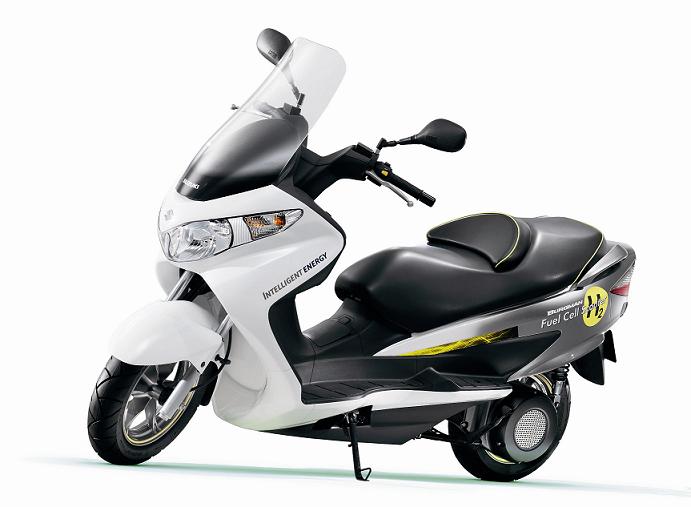
Suzuki Achieves World First With Burgman Fuel Cell Scooter


The following press release from Suzuki discusses its laudable achievement of producing the world’s first fuel cell vehicle to gain approval for safe use on public roads without having to be inspected and tested individually.  Fitting nicely with our article a few weeks ago about hydrogen fuel cell powered vehicles, Suzuki’s breakthrough with this Burgman is part of Suzuki’s effort to make this “a commercially available vehicle.”  Here is the Suzuki press release:

BREA, Calif. March 10, 2011– Suzuki is pleased to announce that the Burgman Fuel Cell scooter has gained Whole Vehicle Type Approval in the European Union – becoming the world’s first vehicle to gain approval for safe use on public roads without having to be inspected and tested individually. This new approval meets standards for safety and performance, representing a milestone in making environmentally-friendly, zero-emissions transportation commercially available for the public.

The Burgman Fuel-Cell Scooter debuted at the 41st Tokyo Motor Show in October 2009, and has been continually tested in the UK since February 2010, gathering information about the bike’s performance on public roads while it gained the Whole Vehicle Type Approval.

Produced in a joint collaboration between Suzuki Motor Corporation and British company Intelligent Energy, the Burgman Fuel Cell scooter utilizes state-of-the-art eco-friendly fuel cell technology, incorporating a light, compact, air-cooled fuel cell positioned inside the frame that efficiently produces electricity through a reaction between hydrogen and oxygen in the air, and discharges only water in the process, providing zero-emissions power.

The new fuel cell-powered scooters are based on Suzuki’s popular city-friendly Burgman model scooters, and boasts the same high build quality, state-of-the-art features and impressive performance as the standard models they are derived from.

Suzuki is pioneering the field of eco-friendly transportation by working toward making the Burgman Fuel Cell Scooter a commercially available vehicle, in line with the establishment of hydrogen-filling stations and other necessary infrastructure.

For more information about the Suzuki Burgman Fuel Cell Scooter, please visit: http://www.globalsuzuki.com/Burgman_Fuel-Cell_Scooter/index.html


Source : http://www.motorcycledaily.com/2011/03/suzuki-achieves-world-first-with-burgman-fuel-cell-scooter/

MD First Look: Motus MST Sport-Tourer


When I hear the phrase “new American motorcycle,” I usually roll my eyes and groan—how many chrome-laden, raked-out customs does the world really need? But when I saw pictures of the new Motus MST I knew there would be no eye-rolling here—unless it was from the ecstasy of being punched back in my seat by the 161 horsepower and 122 ft.-lbs. of torque promised by its unique V-Four powerplant.

Katech Engineering, a supplier of top-shelf racing engines, designed the KMV4 motor. It uses pushrods and a V configuration, but that’s where similarities between this bike and any other motorcycle built in the USA end. Sure, it’s dripping with good ol’ USA traditions—it’s essentially a scaled-down (and chopped in half) version of the famous LS7R motor from the GT1 Corvette, complete with two-valve per cylinder heads with hydraulically adjusted lifters and the aforementioned pushrods—but it’s also packed with 21st-Century high tech. Fueling is by direct injection—something becoming more common in cars but not seen before on a production motorcycle—which means fuel is sprayed directly into the cylinder head for optimum power and efficiency. Displacement is 1650cc, and the very compact mill weighs in at just 130 pounds. The power peak is at 8000 rpm (blame the pushrods and hydraulic adjusters, but with that much torque, who’s complaining?) and I’m going to go out on a limb and predict a particularly orgasmic exhaust note.


The chassis is also something not often (okay, ever) seen on American bikes. Developed by the uber-engineers at Pratt and Miller (developer of many winning racecars and engineers to aerospace and military clients), it’s a Ducati-ish chromoly steel trellis design that uses the KMV4 as a stressed member. With dual counterbalancers to smooth out secondary vibrations, it should be smooth as butter pudding, which means a lighter frame, which means a lighter bike. In fact, the bike should be around 550 pounds with its six-gallon fuel tank topped off. The wheelbase is a sporty 58 inches, and final drive is by a good ol’ chain. Suspension is fully adjustable, and brakes are monstrous rotors with radial-mount, four-piston calipers. An MST-R will also be available with full Öhlins suspenders and Brembo brakes. And carbon-fiber bodywork, of course.
Speaking of bodywork, the Motus’ is minimalistic, but functional. It’s enough to keep the wind off the rider, but not enough to conceal what may arguably be the coolest motorcycle powerplant ever made (suck it, Morbidelli!). There’s also a pair of big Givi sidecases and a wide, scooped-out saddle that’s extra-narrow at the front to let any rider firmly put both feet down.

So this looks like good news and bad news. The good news is it may be the ultimate sport-tourer for all us aging gearheads. Smooth, torquey, good-handling and packed with cool details. It’s the kind of motorcycle I’d imagine airline pilots would ride. With ergonomics “almost identical to Yamaha’s FZ-1,” according to  Motus co-founder Brian Case and that giant gas tank (which should provide a genuine 300 mile range, if the claims of great efficiency are to be believed), the MST may be hard to beat as a sport-tourer.


The bad news is that it’s not really a mass-market bike. According to a New York Times blog post about the bike, Case says Motus will build just “hundreds of bikes per year, not thousands.” Bad news for those of us looking for performance and comfort. I’m guessing the bikes won’t be cheap, either. Nor should they be. It’s pretty clear that demand for a truly American sportbike is small, which means small numbers and big prices—just look at Erik Buell Racing, Roher and Fischer.
Case and Motus President Lee Conn will now be taking the bikes around the country to drum up public support and possibly some dealers. Let’s hope MD gets offered some seat time when they reach the West Coast.

Source : http://www.motorcycledaily.com/2011/03/md-first-look-motus-mst-sport-tourer/

2011 Kawasaki Ninja 1000: MD Long-Term Test, Part 2


We are continuing to thoroughly enjoy our Ninja 1000 test bike. You can see Part 1 of our long-term report here, and read our report from the press introduction of this bike here. We can update you on the gas mileage you can expect if you purchase this model. Below is a table setting forth the four most recent tanks of gasoline we have run through this bike.

Tank # 1 – 170 miles @ 4.46 Gal. = 38.1 MPG
Tank #2 – 128.3 miles @ 3.54 Gal. = 36.3 MPG
Tank #3 – 149.5 miles @ 4.41 Gal. = 33.9 MPG
Tank #4 – 171.1 miles @ 4.02 Gal. – 42.7 MPG
As you can see, when ridden aggressively (as we have), the Ninja 1000 does not return the best gas mileage. Nevertheless, the 43 mile per gallon figure we obtained on Tank #4 was primarily high-speed freeway cruising. Given the large, 5 gallon tank in the Ninja 1000, 200 miles between fill-ups on a highway trip is certainly possible, and this is more than decent range for a sport tourer.

The bike has continued to impress us with its smoothness. We do note some minor vibration through the tank when gripping the bike with our legs above 6000 RPM. It is noticeable, but not an annoyance.


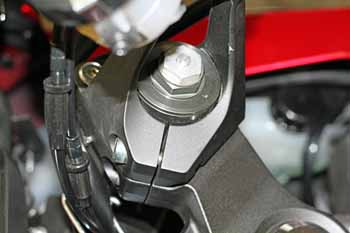
We’ve been trying to dial in the handling. The way the bike was delivered to us by Kawasaki, we thought it turned in slower than the unit we tested at the press introduction a few months ago. As a result, we decided to raise the forks in the triple clamps by 5 mm (see picture). After doing this, we learned that Sport Rider magazine had recommended a similar adjustment. Basically, the Ninja 1000 feels like it needs more weight on the front end. This can be accomplished in a couple of different ways.

You could take the approach we did, or you could try something different (something we may try when we switch tires). You could go with a higher profile rear tire. The Ninja 1000 comes stock with a 190/50 section rear, and you could swap to a 55 section rear (either 190 or 180) to provide a bit more ride height in the back, and also a better tire profile for tipping the bike in the corners.  By raising the forks, the Ninja 1000 not only changes directions more easily, it tracks better, whether in a straight line or through corners.


We wanted to finish testing the bike in stock condition before proceeding with modifications. As we said earlier, we are anticipating an exhaust change, windscreen change, and several other mods. In our opinion, however, the Ninja 1000 is an outstanding motorcycle in stock condition, and a very viable one-bike solution for riders who like to commute, tour and attack the canyons on weekends. Stay tuned.


The manufacturer provided Motorcycle Daily with this motorcycle for purposes of evaluation.

Source : http://www.motorcycledaily.com/2011/03/2011-kawasaki-ninja-1000-md-long-term-test-part-two/

2011 Kawasaki Ninja 1000: MD Long-Term Test, Part 1


After attending the press intro for Kawasaki’s new Ninja 1000, we immediately asked Kawasaki for a test unit.  We will have the bike for a long-term evaluation, and will test it both in its stock form and with assorted modifications.

If you read our First Ride, you will see that we were very impressed by the Ninja 1000.  Its performance is very close to a full-blown superbike, in terms of its engine, chassis and brakes.  Combined with ergonomics that are more comfortable than some sport tourers, very low vibration and a trick, three-position adjustable windscreen that requires no tools (change it at the next stop light, if you desire), we couldn’t wait to see what it would be like to live with the new Ninja for several thousand miles.

The bike has been every bit as impressive as it was at the press intro, and we are preparing a full report on our experiences with the stock model for publication next week.  This is a preview, of sorts, of our long-term test and an opportunity for our readers to suggest modifications to try on our test unit.


We have already taken delivery of a Shorai battery that we will use to replace the stock unit.  Our Shorai (still in its box, pictured) is the LFX18A1-BS12 model, which is the “duration” recommendation for our bike.  We will be talking more about Shorai in our next article, but our unit is a Lithium-Iron battery that is dramatically lighter than the stock unit.  Shorai is an impressive company with its own ISO certified factory, and it claims certain advantages/differentiations over its competitors.  We will tell you how much weight we saved over the stock unit, give you our initial impressions, and discuss Shorai in greater detail in a future article.

We are also expecting an exhaust system from LeoVince.  LeoVince has developed a new “Factory R” exhaust for the Ninja 1000, which is pictured on a green European model below.  Our goal is reduced weight and increased performance without obnoxious sound.  Our understanding is that the Factory R exhaust we will be testing features a removable insert that reduces the standard decibel level.

We also have plans to try out some luggage on the Ninja 1000 because the bike is fully capable of touring.
Stay tuned for our first performance evaluation of the 2011 Ninja 1000, and feel free to offer suggestions.


The manufacturer provided Motorcycle Daily with this motorcycle for purposes of evaluation.

Source : http://www.motorcycledaily.com/2011/02/2011-kawasaki-ninja-1000-md-long-term-test-part-1/

2011 Kawasaki Ninja 1000: MD First Ride


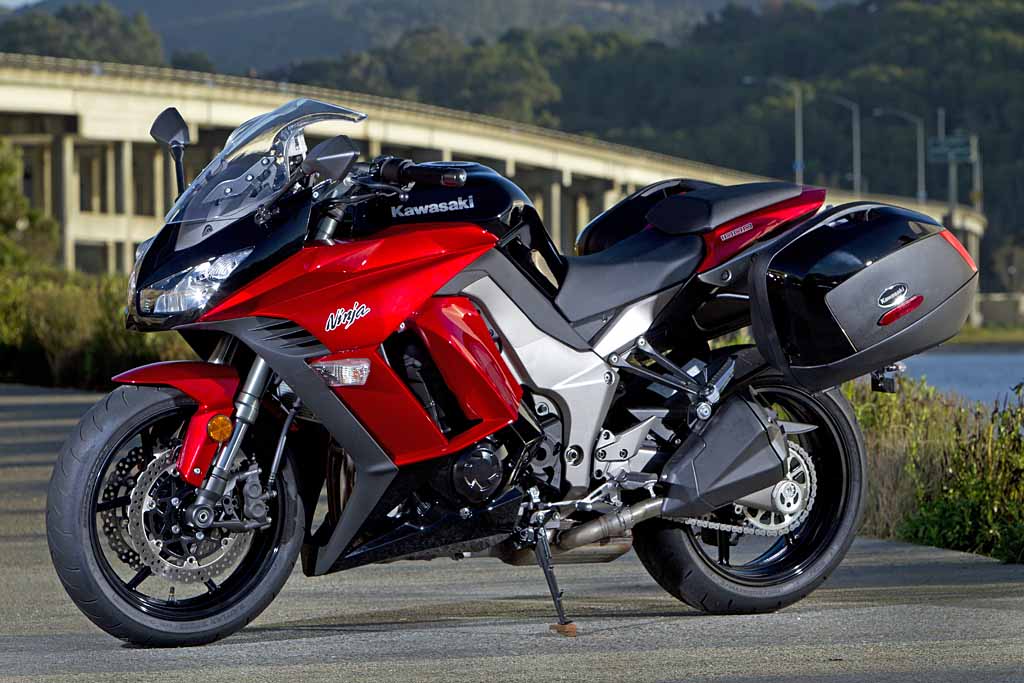
The concept seems simple enough. Take top shelf components designed for a pure sport bike, including adjustable suspension, radial-mounted disk brakes, aluminum twin-spar chassis, and a take–no–prisoners motor and combine these elements with real-world, comfortable ergonomics for the street. Simple, but surprisingly rare among production motorcycles. Kawasaki cannot claim to be the first to do this, as Aprilia and Ducati certainly have followed this formula in the past, but among the Japanese manufacturers the new Ninja 1000 is something special.


The Ninja 1000 shares an awful lot with its naked sister, the Z1000, but this is not a bad thing. We praised  the Z1000, as did virtually every other journalist. The suspension, brakes and engine on this bike put a Japanese naked on the same playing level as the pricier European exotics mentioned above. Moreover, the Z1000 and the Ninja 1000 were developed simultaneously. The Ninja 1000 is not a Z1000 with bodywork slapped on it as an afterthought. This machine was designed from the beginning to serve two purposes, both naked and clothed.

Before we get into our riding impression of the Ninja 1000, courtesy of a romp through the beautiful hills of Marin County, California earlier this week, let’s talk about the essence of this motorcycle, particularly, its engine.


The thoroughly modern 1043cc four-cylinder powerplant is fed by fuel injection and produces awesome power for the street. This is not a de–tuned sport bike engine, it is an engine purpose built to provide more usable street power to the rider than either 1000cc sport bikes or 600cc sport bikes. That’s right, nine times out of ten, this bike is faster on the street than the latest 1000cc superbikes. Most of those superbikes will do 100mph, or more, in first gear, meaning peak horsepower from those engines probably arrives beyond legal speeds in first gear. Will you use that peak horsepower on the street? Generally no, with rare exceptions.
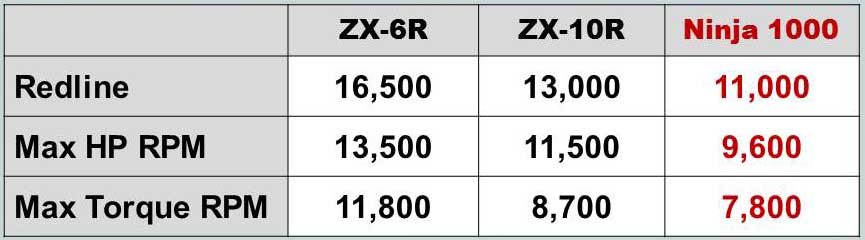
Take a look at this comparison between Kawasaki’s own sport bikes with the Ninja 1000. As our riding confirmed, the Ninja 1000 has power virtually everywhere you will use it on the street… no waiting.

What about peak power? According to Kawasaki, the Ninja 1000 delivers 10% more peak horsepower than the ZX-6R, and 65% more torque. At the same time, although the Ninja 1000 is down on the high RPM horsepower provided by the ZX-10R, it produces the same peak torque at lower RPM.


The adjustable suspension components are slightly smoother and softer than sport bike units, providing a better ride on the street, but still allowing the rider to stiffen up the units for a track day. The 300 mm front disc brakes get radial-mount brake calipers and a radial-pump master cylinder, state-of-the-art for the sport bike class.


Nothing on this bike looks cheap or acts cheap. The swingarm is where many manufacturers save money on a naked, but the Ninja 1000 gets an aluminum swingarm with a built-in eccentric chain adjuster. Unlike a naked, of course, the Ninja 1000 offers excellent wind protection along with a full fairing reminiscent of a sport bike.
That fairing includes a distinctive slat in front of the engine that helps direct hot air away from the rider. During our testing, we did not notice any significant heat coming from the engine, but the weather was cool and hot weather testing would be warranted.

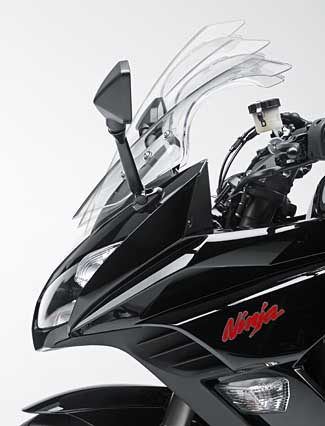
That bodywork and simple, three-position windscreen, provide surprising wind protection, without buffeting. The windscreen assumes one of three positions simply by pushing a button in front of the instrument panel and manually selecting the position desired. No tools and no waiting. You can easily change the position of the windscreen at a stoplight, if you desire.


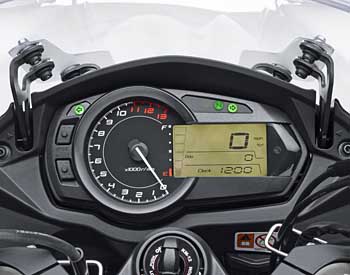
Along with the frame and suspension elements derived from the world of sport bikes, you get light-weight wheels and sport bike instrumentation. The instruments are taken from the ZX-6R, with different fonts and colors. Included is a very legible, traditional analog tachometer next to an LCD screen that includes a speedometer, fuel gauge, clock, dual trip meters and assorted warning lamps. The fuel gauge is easily read at a glance, it is appreciated when combined with the comfort and long-distance touring capabilities of this bike.
The riding position is just about perfect for this 5′10″ test pilot. The bars are higher and closer than many found on sport tourers. The seat is thicker and more comfortable than that typically found on a sport bike. The pegs are a bit high compared to many sport tourers, but still much lower than those found on a pure sport bike.

Those pegs deserve special comment. It is always interesting to note whether a manufacturer paid attention to the important details. Here, along with the smooth engine, Kawasaki took great pains to eliminate any unwanted vibration traveling through the footpegs to the rider’s feet. Both the front and rear pegs are rubber-coated, but the front pegs are also rubber mounted and feature a counterbalancing weight on the heel guard to further reduce vibration. The result is an extremely smooth riding experience that was even a bit surprising when we first pulled out of the parking lot for our test.

Kawasaki even made the passenger seat thicker, longer and wider than those typically found on a sport bike, so that a passenger can experience something short of the torture-rack found at the back of most super sports.
Although the engine is virtually the same as that found in the Z1000, rated at 138 PS at the crank, it has slightly taller final gearing (41 tooth rear sprocket versus 42 on the Z1000). This change reflects the distinct likelihood that the Ninja 1000 will be used for highway touring, but it is not enough of a difference to blunt the stupendous acceleration offered by the bike.


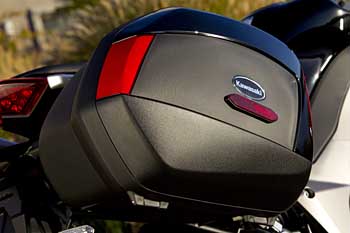
As you might expect, Kawasaki is working on plenty of accessories for this bike. We saw a Ninja 1000 with saddlebags attached, but those are not yet available. Kawasaki promised they would be available soon, however, and you can expect pricing to be similar to the pricing of this accessory on the Versys, since they are the same bags. Different windshields, heated grips and a trunk are also under development.

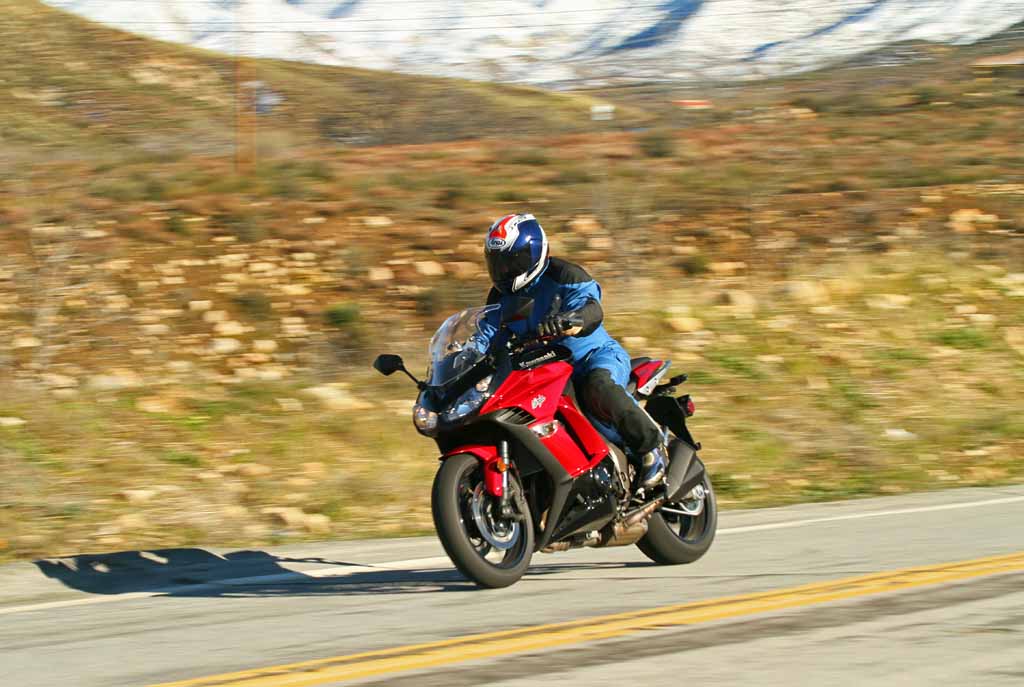
What is it like to ride the Ninja 1000? Not surprisingly, it is similar to riding a Z1000, with the added comfort provided by the windscreen and fairing protection. The bars are in a similar position, but are actually angled a bit more towards the rider. The result is a seating position that was hard to criticize. Sporty enough, but offering comfort worlds beyond a super sport. Most of the time, we ran the windscreen in the middle position. The stock photos you see typically have the screen in its lowest position, but we found the middle position to provide excellent upper body wind protection without buffeting at the helmet level.


Wind protection for the lower body was also excellent. Combined with the low vibration levels, this bike could easily be toured on, and Kawasaki knows it. Our only criticism would be the fact that the seat seems to push the rider forward onto the tank more than it should.
As we have previously reported in the Z1000 test, engine performance is outstanding. The fuel injection is very well dialed in, and transitions from closed to open throttle are quite smooth. The bike will pull from under 3000 RPM smoothly, and provide decent forward thrust above 4000 RPM. Corner exits above 5000 RPM are plenty strong, allowing the rider to roll the throttle on as he stands the bike up, and then feel a bit of a power bump at 7000 RPM as the Ninja 1000 squirts towards the next corner.

The handling of the Ninja 1000 was, perhaps, the most surprising thing about our test. The upright ergonomics and relatively wide bars, coupled with the relatively light weight, and well centralized mass (which the horizontally-mounted shock absorber contributes to), results in a machine that changes directions almost effortlessly relative to other open-class bikes. This nimble nature is coupled with excellent stability and confidence from the front end. Although the front wheel can get light on corner exits, and we sometimes found ourselves slightly crossed-up when hard on the gas.  we never experienced anything remotely resembling head shake, and really learned to trust the front end of this bike.

The transmission performed its duties without complaint, and without requiring much attention from the rider. The brakes are strong and progressive, although we could have used a bit more feel from the powerful front binders.  Our test bike came with excellent Bridgestone  sport bike rubber.

The Ninja 1000 is an excellent motorcycle. After just one day of testing, coupled with our knowledge of the Z1000 from earlier tests, we can confidently say the Ninja 1000 is an outstanding motorcycle, and one of the most versatile motorcycles we have ever ridden. There is very little compromise in this machine. Can it run with sport bikes in the twisties? No question about it, and it will exit corners harder than most sport bikes without paying too much attention to where the tachometer is pointing when you pull the trigger. Does it  work droning along in a straight line on the super slabs? Absolutely, and rider fatigue won’t be much different than the fatigue experienced on a modern sport tourer.  Touring, commuting, play riding on the weekends . . . the Ninja 1000 can clearly do all of these things, and do them quite well. The 5 gallon fuel tank (1 more gallon than the Z1000) should provide plenty of range (although we didn’t take fuel consumption figures at the press launch, we traveled over 120 hard riding miles without refueling, and the bike seemed to have a fair amount of gas left).


Will the Ninja 1000 sell well in the United States? That is hard to predict, but American attitudes certainly work against it. Younger riders want pure sport bikes, regardless of the fact that these bikes are generally slower on the street. These riders won’t think about the fact that they can’t live above 10,000 RPM on public highways. Nevertheless, there seems to be emerging a more mature, thoughtful American consumer for motorcycles.  This could be the Ninja 1000’s saving grace. These consumers will get an extraordinarily versatile motorcycle. They will get a motorcycle at a price significantly below the price of the latest-and-greatest, open-class superbike, while benefiting from many of the same top shelf components and performance capabilities. Oh yeah, and they might also save some money on chiropractor visits and Advil purchases.

The Ninja 1000 will be in U.S. dealer showrooms in the two colors pictured shortly after you read this at an MSRP of $10,999.  Visit Kawasaki’s web site for additional details.
Motorcycle Daily attended a manufacturer-sponsored event, to which selected members of the press were invited, to facilitate this report.

Source : http://www.motorcycledaily.com/2010/10/2011-kawasaki-ninja-1000-md-first-ride-2/