

The Ninja 1000 shares an awful lot with its naked sister, the Z1000, but this is not a bad thing. We praised the Z1000, as did virtually every other journalist. The suspension, brakes and engine on this bike put a Japanese naked on the same playing level as the pricier European exotics mentioned above. Moreover, the Z1000 and the Ninja 1000 were developed simultaneously. The Ninja 1000 is not a Z1000 with bodywork slapped on it as an afterthought. This machine was designed from the beginning to serve two purposes, both naked and clothed.
Before we get into our riding impression of the Ninja 1000, courtesy of a romp through the beautiful hills of Marin County, California earlier this week, let’s talk about the essence of this motorcycle, particularly, its engine.

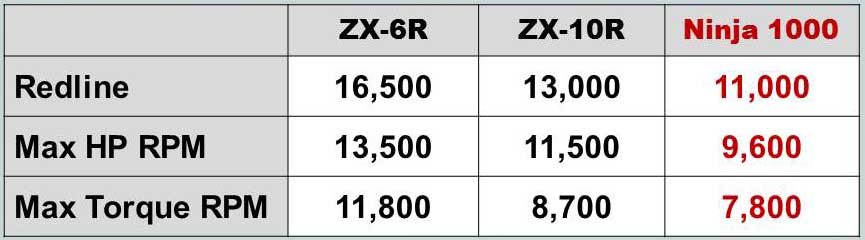
Take a look at this comparison between Kawasaki’s own sport bikes with the Ninja 1000. As our riding confirmed, the Ninja 1000 has power virtually everywhere you will use it on the street… no waiting.
What about peak power? According to Kawasaki, the Ninja 1000 delivers 10% more peak horsepower than the ZX-6R, and 65% more torque. At the same time, although the Ninja 1000 is down on the high RPM horsepower provided by the ZX-10R, it produces the same peak torque at lower RPM.
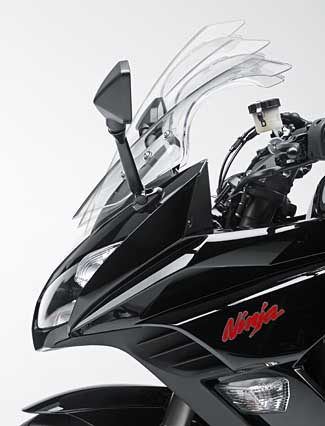
That fairing includes a distinctive slat in front of the engine that helps direct hot air away from the rider. During our testing, we did not notice any significant heat coming from the engine, but the weather was cool and hot weather testing would be warranted.
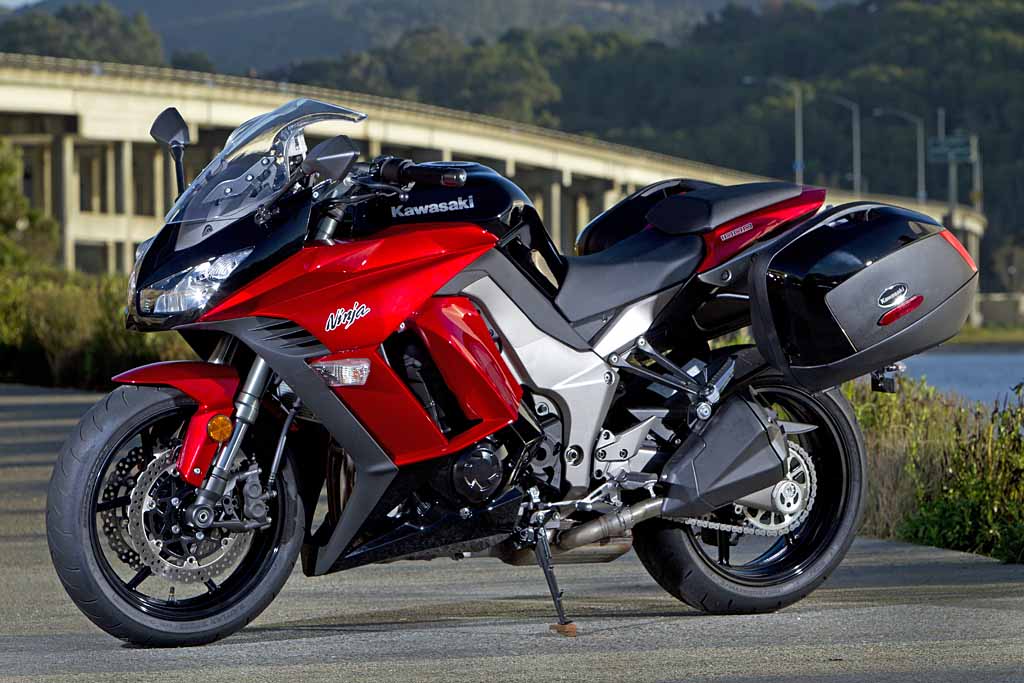
That bodywork and simple, three-position windscreen, provide surprising wind protection, without buffeting. The windscreen assumes one of three positions simply by pushing a button in front of the instrument panel and manually selecting the position desired. No tools and no waiting. You can easily change the position of the windscreen at a stoplight, if you desire.
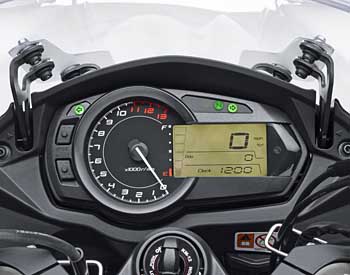
The riding position is just about perfect for this 5′10″ test pilot. The bars are higher and closer than many found on sport tourers. The seat is thicker and more comfortable than that typically found on a sport bike. The pegs are a bit high compared to many sport tourers, but still much lower than those found on a pure sport bike.
Those pegs deserve special comment. It is always interesting to note whether a manufacturer paid attention to the important details. Here, along with the smooth engine, Kawasaki took great pains to eliminate any unwanted vibration traveling through the footpegs to the rider’s feet. Both the front and rear pegs are rubber-coated, but the front pegs are also rubber mounted and feature a counterbalancing weight on the heel guard to further reduce vibration. The result is an extremely smooth riding experience that was even a bit surprising when we first pulled out of the parking lot for our test.
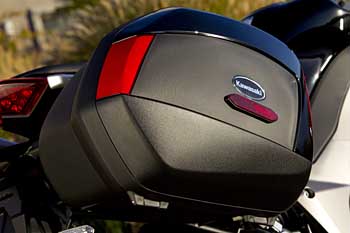
Kawasaki even made the passenger seat thicker, longer and wider than those typically found on a sport bike, so that a passenger can experience something short of the torture-rack found at the back of most super sports.
Although the engine is virtually the same as that found in the Z1000, rated at 138 PS at the crank, it has slightly taller final gearing (41 tooth rear sprocket versus 42 on the Z1000). This change reflects the distinct likelihood that the Ninja 1000 will be used for highway touring, but it is not enough of a difference to blunt the stupendous acceleration offered by the bike.
What is it like to ride the Ninja 1000? Not surprisingly, it is similar to riding a Z1000, with the added comfort provided by the windscreen and fairing protection. The bars are in a similar position, but are actually angled a bit more towards the rider. The result is a seating position that was hard to criticize. Sporty enough, but offering comfort worlds beyond a super sport. Most of the time, we ran the windscreen in the middle position. The stock photos you see typically have the screen in its lowest position, but we found the middle position to provide excellent upper body wind protection without buffeting at the helmet level.
As we have previously reported in the Z1000 test, engine performance is outstanding. The fuel injection is very well dialed in, and transitions from closed to open throttle are quite smooth. The bike will pull from under 3000 RPM smoothly, and provide decent forward thrust above 4000 RPM. Corner exits above 5000 RPM are plenty strong, allowing the rider to roll the throttle on as he stands the bike up, and then feel a bit of a power bump at 7000 RPM as the Ninja 1000 squirts towards the next corner.
The handling of the Ninja 1000 was, perhaps, the most surprising thing about our test. The upright ergonomics and relatively wide bars, coupled with the relatively light weight, and well centralized mass (which the horizontally-mounted shock absorber contributes to), results in a machine that changes directions almost effortlessly relative to other open-class bikes. This nimble nature is coupled with excellent stability and confidence from the front end. Although the front wheel can get light on corner exits, and we sometimes found ourselves slightly crossed-up when hard on the gas. we never experienced anything remotely resembling head shake, and really learned to trust the front end of this bike.
The transmission performed its duties without complaint, and without requiring much attention from the rider. The brakes are strong and progressive, although we could have used a bit more feel from the powerful front binders. Our test bike came with excellent Bridgestone sport bike rubber.
The Ninja 1000 is an excellent motorcycle. After just one day of testing, coupled with our knowledge of the Z1000 from earlier tests, we can confidently say the Ninja 1000 is an outstanding motorcycle, and one of the most versatile motorcycles we have ever ridden. There is very little compromise in this machine. Can it run with sport bikes in the twisties? No question about it, and it will exit corners harder than most sport bikes without paying too much attention to where the tachometer is pointing when you pull the trigger. Does it work droning along in a straight line on the super slabs? Absolutely, and rider fatigue won’t be much different than the fatigue experienced on a modern sport tourer. Touring, commuting, play riding on the weekends . . . the Ninja 1000 can clearly do all of these things, and do them quite well. The 5 gallon fuel tank (1 more gallon than the Z1000) should provide plenty of range (although we didn’t take fuel consumption figures at the press launch, we traveled over 120 hard riding miles without refueling, and the bike seemed to have a fair amount of gas left).

The Ninja 1000 will be in U.S. dealer showrooms in the two colors pictured shortly after you read this at an MSRP of $10,999. Visit Kawasaki’s web site for additional details.
Motorcycle Daily attended a manufacturer-sponsored event, to which selected members of the press were invited, to facilitate this report.
Source : http://www.motorcycledaily.com/2010/10/2011-kawasaki-ninja-1000-md-first-ride-2/


0 commentaires:
Enregistrer un commentaire